In 2024, I developed debilitating chronic illness due to farm work injuries and the stress of political organizing. This collapse forced me to reckon with the ways that internalized ableism has shaped my life, and to see the ableist culture that was normalized in the supposedly liberatory spaces where I worked and organized. These illustrations capture just a few moments of me experiencing and reckoning with the ableism baked into land work.
My Liberation Work has been Damn Ableist
Issue 12
https://manyworlds.place/entries/issue-12/maze-raghavan-cohen/
Jump to: Introduction ・ Future ・ Fish Guts ・ Farmer yells at me for eating processed tortillas.
Introduction
Future
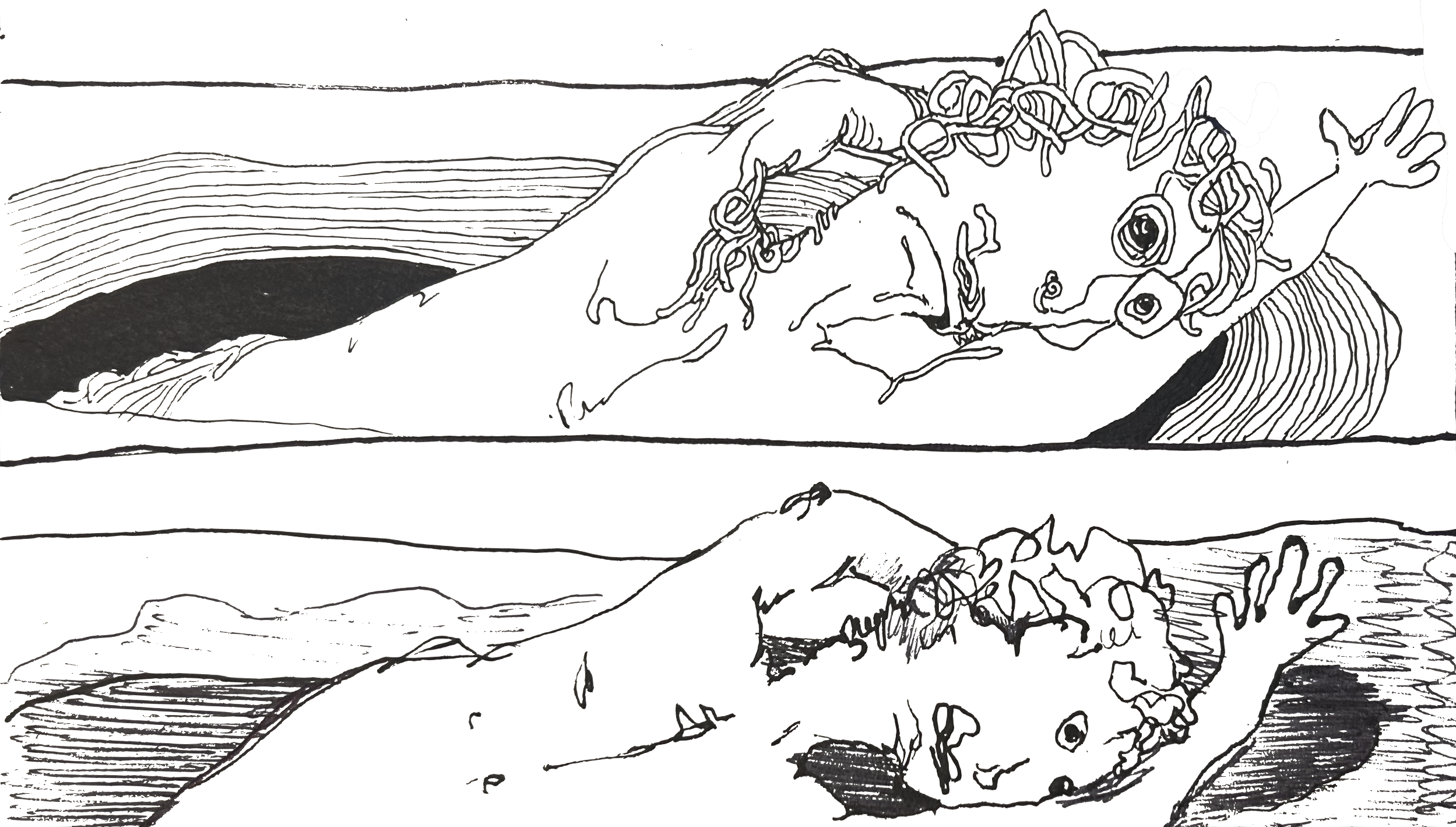 There are two stacked parallel images of a person lying on the ground with their head turned towards the viewer. Both are black and white line drawings and each one has a slightly different style. The person has one arm out in front of them and another arm under their head. They are looking towards the floor in the direction of the reader. Both have an expression with wide eyes and a squiggly mouth that’s exhausted but also like “ohhh sh*t what have I done.”
At the height of my illness, I spent weeks lying on the floor of a rent-free yurt meditating through overwhelming pain and pondering how I got there. After spending my childhood being bullied and institutionalized for my neurodivergences, I had shaped much of my adult personality around masking my disabilities to stay safe. When I became sick, my abled mask collapsed, and my sense of self along with it. While this collapse was miserable, I wouldn’t have slowed down to reflect without it. Ultimately, reckoning with my own internalized ableism was exactly the work that was needed to lower my pain levels and rebuild my life.
Fish Guts
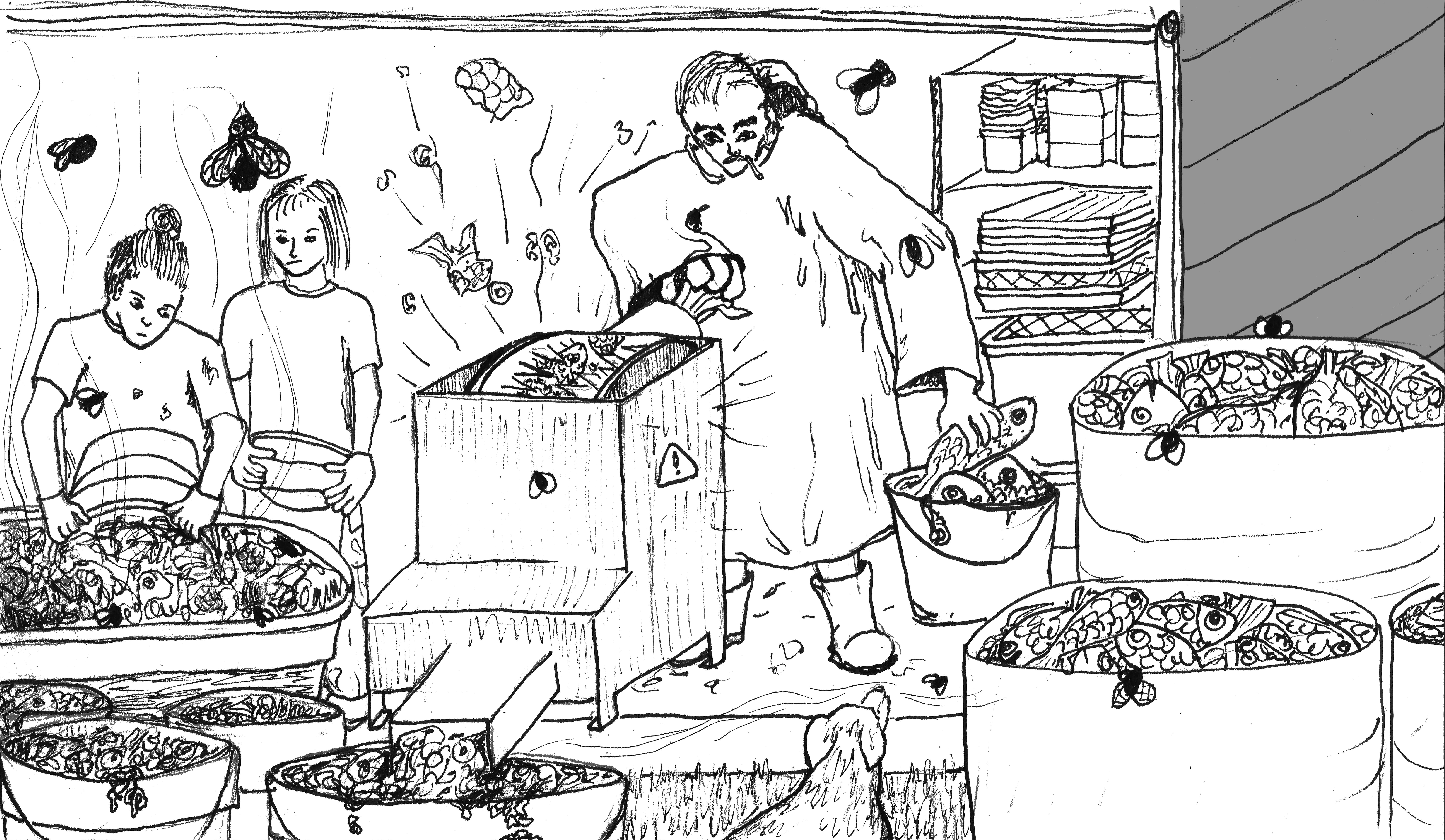 A sketch of three people grinding fish in a garage. One person in a poncho feeds the tail of a fish into a fish grinder machine, while they grab another fish from a bucket. Two people scoop bucketfulls of ground up fish from a big tub. In front of the garage there are many barrels of whole fish and buckets of ground fish. At the bottom of the page, a dog is sniffing out the fish. Around the page, chunks of fish bits are tossed around and huge flies fly about.
One of the most absurd weeks of my life. One day my boss dropped off 6 barrels of dead fish in my driveway, which I was supposed to process into fertilizer (I was told this is something the organization does often, but I could not seem to get an answer about the usual process). My coworker (pictured in the giant poncho) decided she was the only one competent to handle the (admittedly very scary) fish grinding machine, but spent the week yelling at us about how she was doing all the work. We had thousands of fish and this was a one-fish-at-a-time grinder. She ground up the fish into tubs and I transferred it to the gardens bucket by bucket in the back of the farm truck (which smelled putrid for months), with the help of two incredibly resilient volunteers who happened to be there that week. The project was absurd, but what else can you do when you have thousands of fish already in your driveway? The first few days were nasty but ok, but, if I’m remembering correctly, it took about a week to process all the fish. If you leave tubs of ground up fish in your driveway for a week…well, the smell of rotting death was like nothing I’ve ever experienced. I saw bigger flies than I knew existed, at least 2 inches long. When I think of farmers and organizers choosing to struggle unnecessarily, I think of this week. My coworker’s dog (pictured on the bottom) almost died from eating rotten fish. This dog reminds me of how creation always comes with destruction, which is why we must be care-full in our creation. The fact that we all came out okay (physically, if not emotionally) blows my mind.
Farmer yells at me for eating processed tortillas.
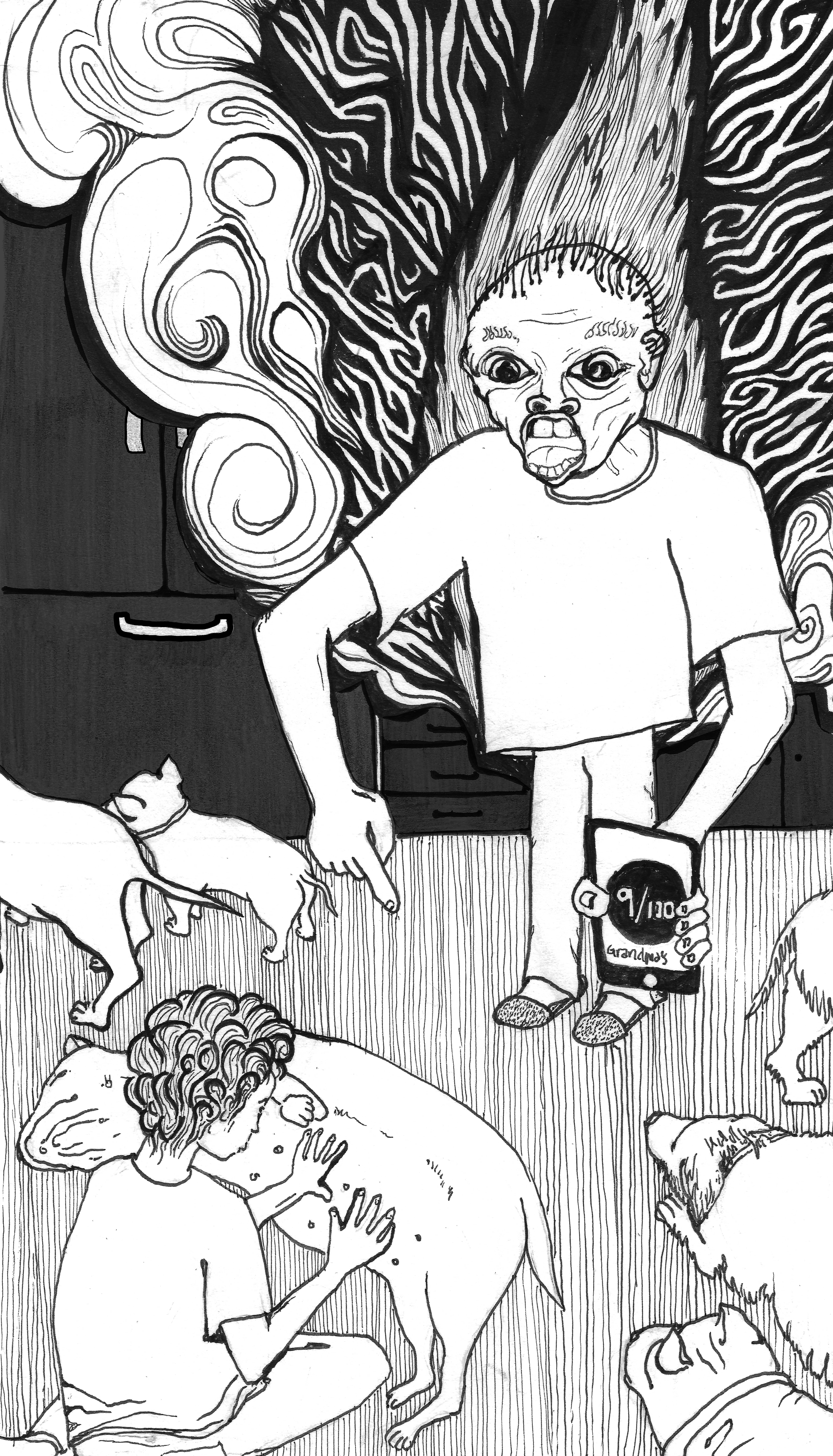 A man stands above me holding out his phone and pointing to it with the other hand. The phone reads “9/100.” The man is screaming. His anger is shown dramatically with clouds of fire and smoke surrounding him. I kneel on the ground below him and look down at the dog I am petting. There are five other dogs wandering around.
The man screaming at me here is my work exchange host at a small permaculture project. I focus on petting his many dogs while I prepare my response. But what do you say when someone screams at you for having processed tortillas? The first time he found my tortillas in the fridge he told me they received a 9/100 on his nutrition app so I shouldn’t eat them - LOL. I told him I didn’t care. Then when I told him I had to leave because of health issues, he showed me the app, and yelled at me about how the tortillas must be the cause of my health issues. Ironically, these are tortillas I bought from the general store near my former home when I ran out of food and my disability made it impossible for me to drive the 1 hour to a grocery store - not to shade the tortillas, they’re quite average.
This moment perfectly captured a culture I’ve sometimes experienced in farm spaces where people tell you they know the answers to your health problems because they’re into holistic healing. As in “if you were smarter and more enlightened like me, you would be healthy like me.” I’ve been reading that this kind of ableism gives people a sense of control to abate their own fears of illness.
Maze’s creative work spans visual art, writing, herbalism, land stewardship, farming, social practice, and community organizing. In every project, they create microcosms of home and healing, as a descendant of Ashkenazi and South Asian lineages of diaspora, genocide, queerness, madness, and disability. Their work is an offering to their trans, disabled, and POC collaborators and communities to guide, resource, celebrate, and heal. Maze’s practice is inspired by their hallucinations and neurodivergent experience, as well as the visual patterns shared across human and ecological bodies.
From about 2019 to 2024, their practice focused on building physical spaces of liberation through participatory permaculture design and community organizing, before transitioning to be a full-time artist. Since then they have exhibited work at Art Thou Neurodivergent and the Harwood Arts Center, completed a three-month residency at Olamina Global Arts, and published a chapbook titled My Liberation Work Has Been Damn Ableist. You can see more of their work here, get updates here, and read/buy their chapbook here.